
Sea Wave Granite Garden Ideas
Pale Gray-Veined Paving, Paths, Stepping Stones & Edging for Outside
One Pale Stone for the Whole Plot
Flamed or natural-split Sea Wave granite, cut into 24x24 inch pavers and setts, makes a bright, hard-wearing surface for a garden path, terraces and planted borders outside. The most restful exterior schemes use a single material again and again. Sea Wave is a Chinese white granite with a bright ground crossed by fine flowing gray veining — pale enough to make a small yard feel larger, lively enough to read as natural stone rather than concrete. Used across paving, edging, walls and steps it ties the whole outdoor scheme together without a single accent material competing for attention. The pale ground also bounces light back into shaded seating corners, so the area stays usable longer into the evening than it would under dark slate or charcoal tiles. Start with the finished pieces on the Sea Wave granite pavers product page, then carry the same stone everywhere your feet and your eyes travel.
Paved Terraces and Winding Walkways
Terraces work best in generous 24x24 inch slabs with a flamed or natural-split face that stays slip resistant after rain. A flamed face opens the quartz grains for grip under wet shoes, while a natural-split face adds a rougher, riven character that suits older or cottage-style properties. From the terrace, let a narrower walkway curve away through the planting — the change of scale signals a slower, more exploratory route and pulls the eye toward whatever waits at the far end: a bench, a tree or a borrowed view over the fence.
Crazy paving, as in the photograph above, gives the most informal feel: irregular pieces fitted with tight joints read as aged stone and forgive the gentle curves a strict grid cannot. Allow 8 to 12 inches of compacted hardcore with a grit bed under the pieces, keep joints a consistent finger-width and point them with a resin-bound compound so no weeds take hold. On a compacted base like that, a paving run will outlast every timber and composite alternative on the site, and a pressure wash once a season is all the upkeep it needs.
Stepping Stones Through Lawn and Planting
Individual stepping stones are the lightest way to put stone on grass. Cut as thick single pieces, laid level and spaced to a comfortable stride of roughly 24 inches center to center, they float across a lawn or border without the formality of a continuous surface. They are also the easiest first project for anyone trying granite: a dozen pieces turn a muddy shortcut into a deliberate feature, and they can be added to later when the rest of the build follows.
Set each piece a hair below mowing height so the mower passes cleanly over the top, and bed it on a small footprint of grit so it never rocks. On sloped ground, pair the stones with low risers from the same material so the route stays even underfoot in wet weather; cut-to-size treads and risers are detailed on the Sea Wave steps and stairs page. For a softer look, let low planting — thyme, creeping jenny or moss — creep into the gaps between pieces so the stone gradually settles into the green.
Raised Beds, Edging and Low Stone Walls
Granite is where hard landscaping earns its structure. Raised beds edged with coping stones give planting a clean horizon line and double as casual seating, while loose-stone walls built from split blocks with a flat coping cap retain changes of level on sloped sites. Keep the bed edging at 12 to 16 inches high for a seat-friendly edge, and cap it with a flat coping piece overhanging the face by about an inch on each side; that shadow line is what makes built stonework look properly finished.
The bed and wall pieces come from the same block stock as the paving, so the gray veining matches across horizontal and vertical surfaces — a detail that reads as intentional when the eye travels from terrace to wall. Low walls of split blocks laid in a loose pattern also give planting a warm backdrop: pale stone behind deep green foliage and flower color makes borders photograph well in any season. Cut-to-size cube stones and edging are detailed on the Sea Wave cube stones and edging page.
Terraces That Step With the Slope
On sloped sites, let the stone solve the levels. A paved terrace at the house, a short run of steps, then a second smaller terrace in the planting turns an awkward bank into three usable rooms outside. The steps and terrace surfaces share one finish, so the eye reads one continuous exterior floor stepping down the plot rather than a set of unrelated structures. Comfortable proportions for outdoor risers are around 5 to 6 inches with deep treads of 13 inches or more, so the stairs feel generous rather than steep.
Cut-to-size treads and risers can be numbered from your setting-out drawing before they leave the works, which keeps on-site work down to laying rather than cutting and means a small crew can install a full run in a couple of days. Where a flight meets planting, finish the side cheek with the same split blocks used on the low walls so the run of steps grows out of the boundary rather than sitting on top of it.
Sampling, Matching and One Stone for the Whole Home
Two practical points make a stone scheme easy to buy. First, sample before you commit: a single piece in your own light and against your planting tells you more than any photograph, and sample pallets convert seamlessly into full container loads for larger programs. Second, order the whole project from one production lot — paving, path stones, edging and walls — so the pale gray tone stays consistent from the terrace to the back wall. The same Sea Wave batch can continue indoors as kitchen floors and worktops, and poolside as bullnose copings on the Sea Wave pool copings page, so the stone you chose for the walkway is the stone you meet at the terrace, the water and the kitchen — one material, one lot, one tone across the property. Material grades, tolerances and certificates worth checking before you order are summarised in our Sea Wave granite selection guide.
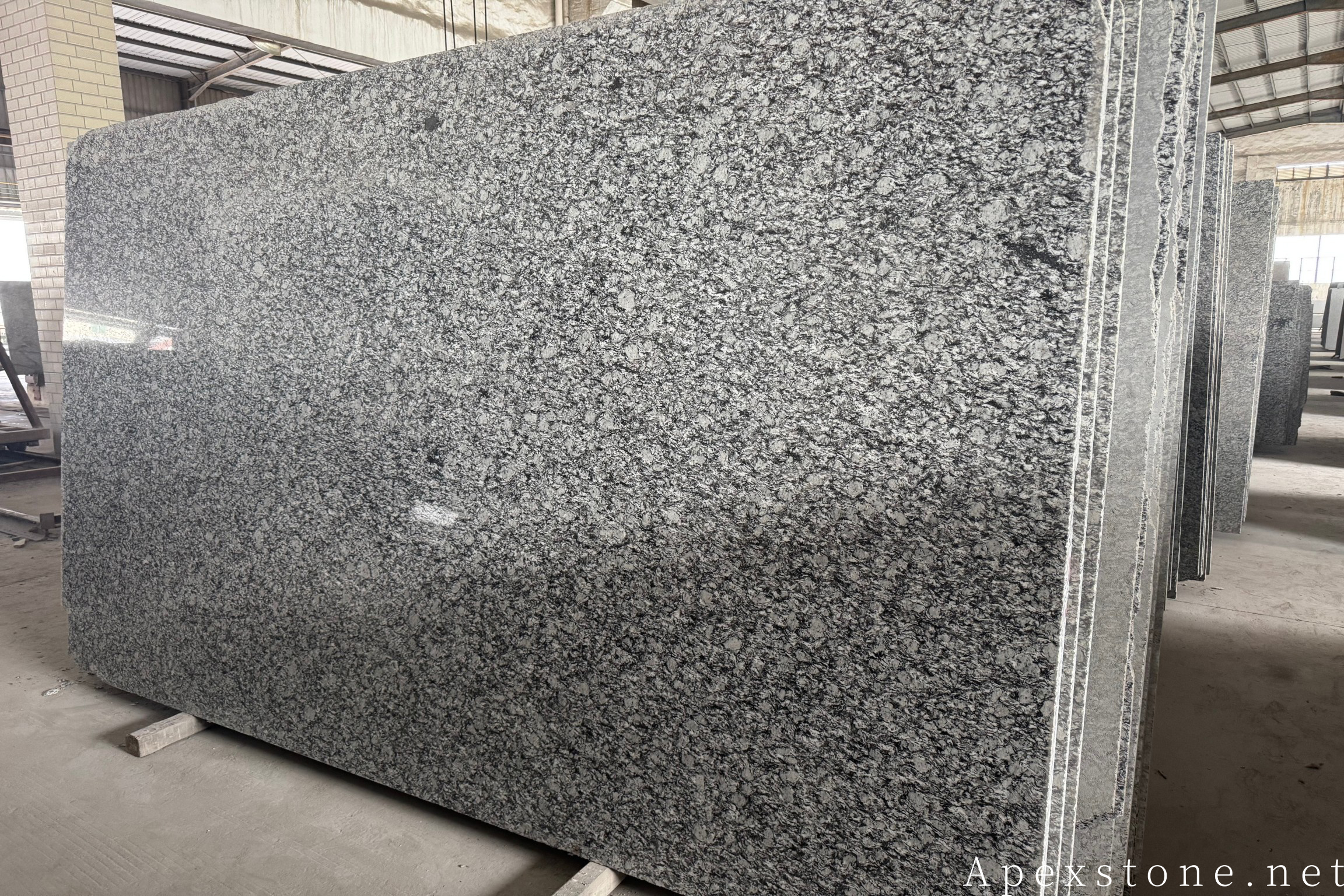
Laying details are worth deciding before the first pallet arrives. Crazy paving and stepping pieces want a compacted hardcore base with a grit bed, while regular 24x24 inch slabs can be wet-laid on mortar for a crisp, furniture-flat terrace; your contractor will choose by ground conditions and the finish you order. Flamed faces suit the main walking routes, natural-split faces suit walls and bed edging where a rougher, stacked-stone look helps, and sawn-and-honed edges keep poolside and step edges comfortable under bare feet. All of these finishes come off the same block stock, so mixing them across one scheme never shifts the color.
Day-to-day care is deliberately simple. A soft brush and a neutral cleaner handle routine dirt, and an occasional light pressure wash brings the veining back to its original brightness after a wet winter; the dense siliceous body absorbs almost nothing, so no annual sealing is required outside. Avoid de-icing salts on newly laid joints for the first season, and keep furniture on wide pads so nothing stands in a pool of water for months — habits that keep pale paving looking freshly laid for years.
Choosing Pieces for an Exterior Makeover
If the project is a refresh rather than a new build, prioritise the areas you walk on every day: the main terrace, the route to the door and the walkway that links the house to the gate. An exterior surface in a pale, reflective stone like Sea Wave makes north-facing or tree-shaded corners measurably brighter at dusk, which is why exterior designers reach for light granites in exactly those spots. Buy the dominant surface first — the terrace paving — then match the edging, wall caps and step treads to the same lot, so later additions never fight the original tone of the planting scheme.
A practical rollout starts with the walkways and terrace in season one, adds the raised beds and low walls once the planting plan is settled, and finishes with the details — wall caps, coping edges and indoor floors — once the outside rooms prove their layout. Ordering every piece from one lot means the stones added in year two still match the stones laid on day one, which is the quiet payoff of choosing a single stone family from the start.
Application Ideas


Frequently Asked Questions
What can Sea Wave granite be used for outside?
Does granite paving survive freeze-thaw winters?
How do I lay out a path with granite setts and slabs?
Can I order small quantities for a single project?
Sea Wave Granite for Outdoors
Sea Wave Granite Pavers
Cut paving and setts for terraces and walkways, with finishes and specs.
Sea Wave Cube Stones & Edging
Setts, cobbles and raised-bed edging to border planted areas.
Sea Wave Steps & Stairs
Cut-to-size treads and risers for sloped sites and level changes.
Sea Wave Pool Copings
Matching bullnose coping when the planting runs to the water.
Planning a Sea Wave Stone Plot?
Send your layout and areas for paving, walkways, edging and walls — our team quotes within 48 hours and ships sample pieces first.