
Sea Wave Granite Kitchen Ideas
Countertops and Island Tops for Budget-Friendly Renovations
The Budget Case for Pale Granite Counters
Honed Sea Wave granite countertops and island tops in full slabs, cut to size for a budget kitchen renovation, bringing natural stone to the heart of the home.
A countertop upgrade is the single change that does the most for a tired room — it is the surface every visitor leans on, every morning starts on, and every photograph catches. The catch is that pale, flowing stone from famous quarries is priced like jewellery, which is why most reno budgets end on engineered sheets or laminate instead. Sea Wave changes that maths: as a Chinese white granite produced in large, consistent blocks, it reaches the fabricator at roughly 220 RMB per square meter ex-works — a fraction of imported pale stone prices — while its dense siliceous body, rated 6 to 7 on the Mohs scale, outwears every engineered alternative on heat and knife contact. The result is a countertop budget that covers real stone rather than an imitation of it, with the same look design magazines present as high-end work.
The whole-home logic is where the savings compound: because the Sea Wave granite slabs are cut to order in one works, the island, perimeter runs, backsplashes and even a dining table top come from the same block at the same price point. There is no coordinating suppliers, no color mismatch between rooms and no second freight bill. That one-stone discipline is also the oldest designer trick for making a modest space read as considered: a room where every hard surface belongs to the same stone family looks far more expensive than one wearing a patchwork of samples.
White Cabinets and Gray Veining: The Classic Budget Layout
The most cost-effective look in the photographed schemes is also the most timeless: white shaker or simple flat-panel cabinets below a pale, veined stone top. White painted doors are the cheapest cabinet finish to source and repaint, and the gray wave veining of Sea Wave supplies all the character the room needs, so the budget goes into stone and hardware rather than exotic timber or applied trim. Bright countertops bounce daylight through the room, which makes a small windowless space feel larger — an effect no dark material can offer at any price.
Keep detailing plain to keep the quote low: standard height backsplash rather than a full slab upstand, simple eased or beveled edges rather than built-up ogee stacks, and standard depths so fabricators cut with minimum waste. Warm wood stools, brass or matte-black handles and a ceramic apron or undermount sink are the accents that finish the look for well under a premium-material budget — a rococo-style faucet or statement pendant adds the period note if your taste runs traditional, while the stone stays quiet and bright beneath it all.
Islands and Peninsulas: One Big Slab Does the Talking
If the budget stretches to one generous surface, let it be the island itself. A large uninterrupted top in pale natural stone is the element guests photograph, and it doubles as prep zone, breakfast bar and homework table — utility that justifies every meter. Fabricators often cut the island top from the same slab as the perimeter runs, which keeps the pattern continuous across the room and means the island pieces ride in the same container as the rest of the order rather than as a separate purchase.
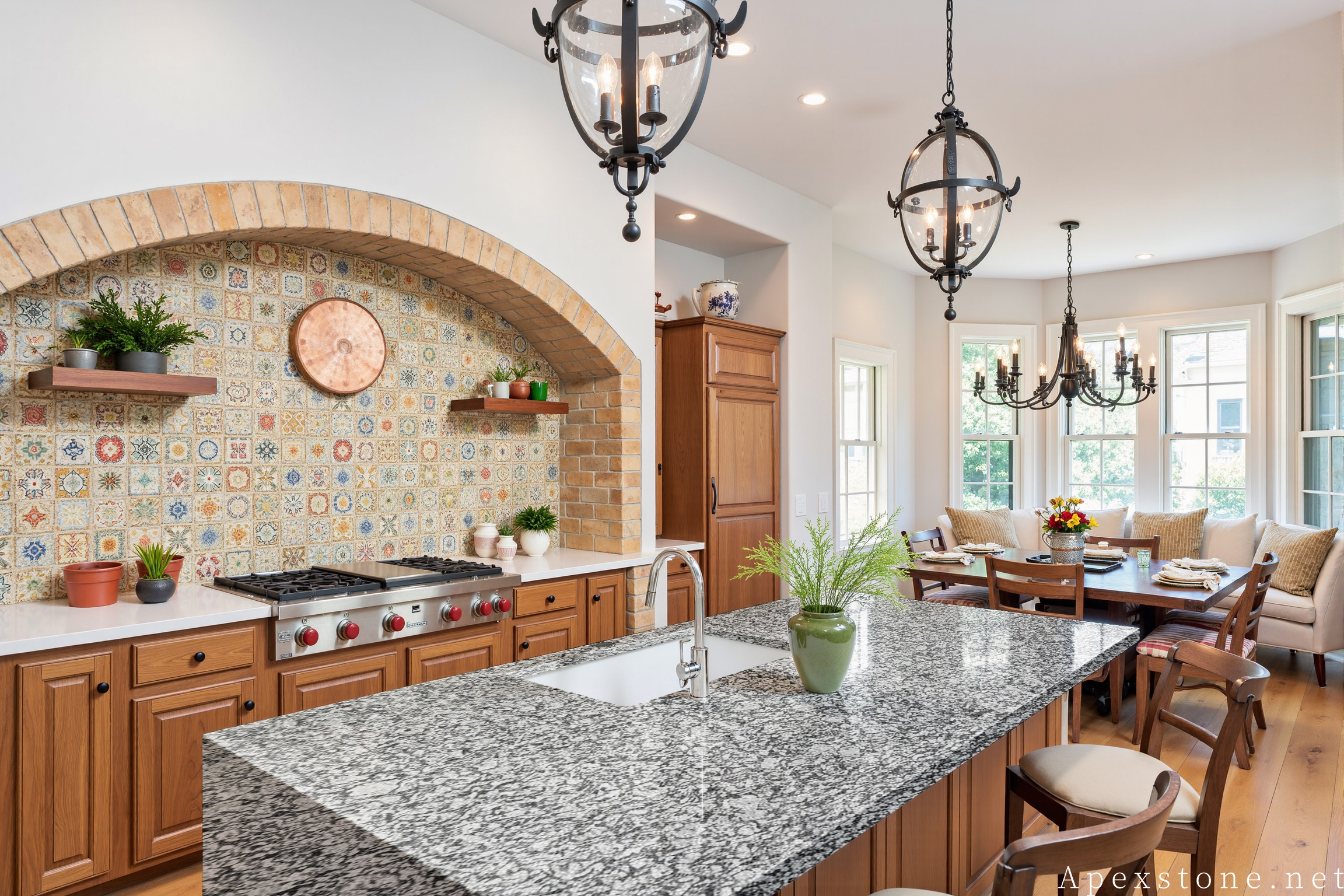
For traditional homes the island pairs naturally with a raised bar lip or turned furniture legs, as the traditional dining-area scheme above shows; for contemporary layouts a flat waterfall end in the same 2 cm or 3 cm stone adds the showroom look at little extra fabrication. Overhangs of 25 to 30 cm (10 to 12 inches) cover standard bar stools without support brackets on most island lengths, and the dense granite body means the cantilevered edge does not sag or crack under everyday leaning.
Sink Zones: Stone Tops with Ceramic Basins
The most practical sink setup for a value-driven build pairs the stone top with a white ceramic undermount basin — exactly what the photographed homes use. Ceramic basins are inexpensive, hygienic and forgiving of dropped mugs, and the clean white rim against gray veined stone reads as classic and bright rather than economical. A single sink bowl in a 70 to 80 cm (28 to 30 inch) base unit covers nearly all prep and washing tasks, and one cutout costs a fraction of a multi-bowl or drainer-groove layout.
Undermounting is the detail worth paying for: the basin sits below the stone, so crumbs wipe straight off the counter into the bowl with no rim trap, and the stone edge around the opening is finished and sealed in the workshop rather than on site. Buyers who later want the fully carved look can upgrade to a hand-carved Sea Wave solid granite sink cut from the same matching stone — it is the premium option, not a necessity, and the ceramic basin can always be swapped out when the upgrade happens.
Cut-to-Size Tops, Finishes and Edge Details
Countertops leave the workshop cut exactly to the cabinet maker's drawing: cutouts for the basin and hob, finished end panels, splashbacks to match, and every piece keyed to a layout number so installation is an assembly job rather than site cutting. The workshop photograph below shows a finished top with its sink cutout and edge profiling done before crating — pre-finishing like this is what keeps on-site fitting to a single day and avoids the dust and re-cuts that inflate installation bills.
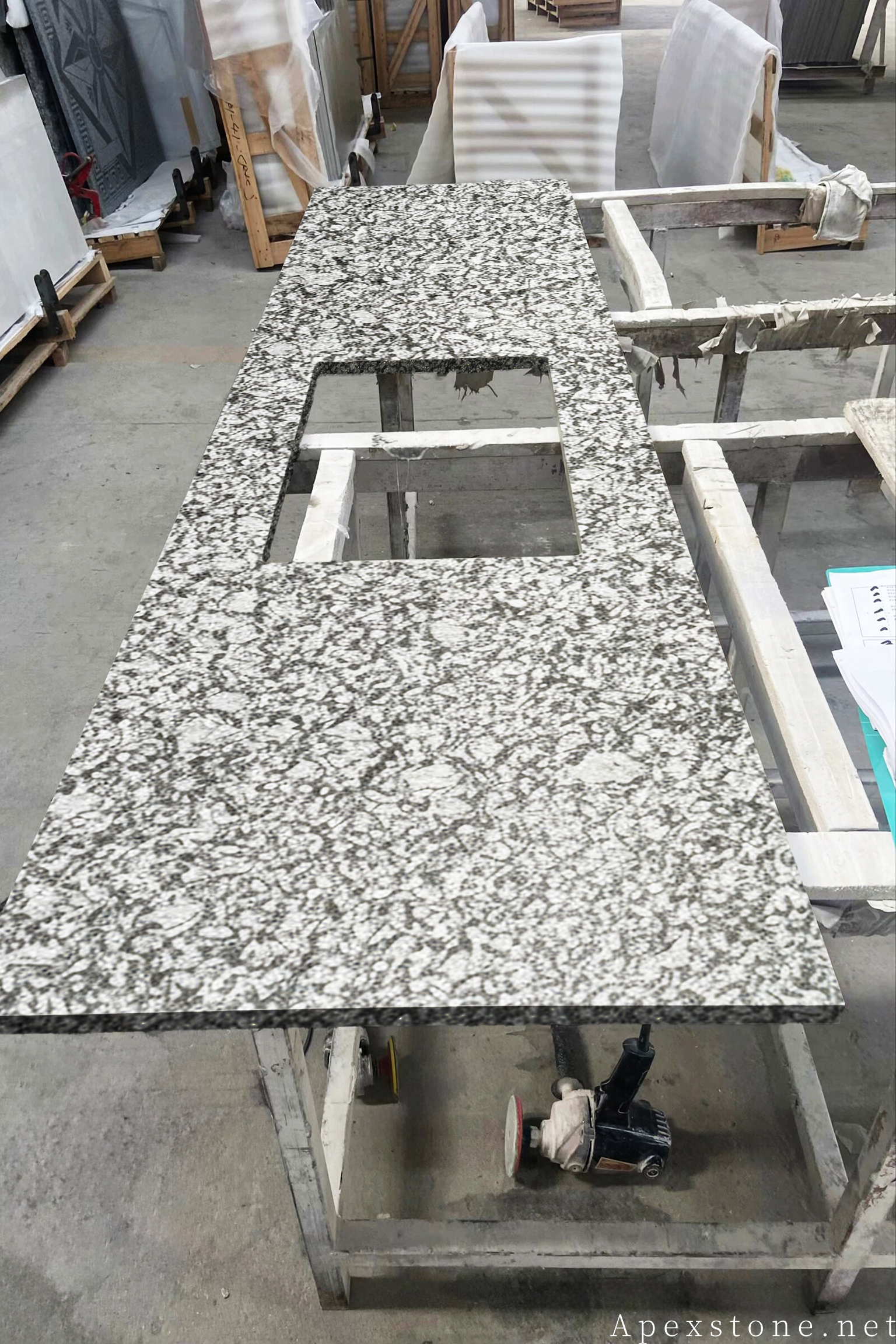
Two faces cover nearly every countertop order. The bright reflective finish, achieved by passing slabs under sequential grinding and polishing heads until the surface mirrors window light, is the standard choice for prep zones, because it seals the dense surface completely and wipes clean after flour, oil or sauce. A matte honed face is the softer alternative for homes already mixing textures; textured and brushed faces exist for accent surfaces but the dimpled grip is unnecessary on a counter and slightly slower to wipe. On edge profiles, a simple eased or small beveled edge is both the cheapest and the most modern; layered ogee and dupont profiles add fabrication hours that the pale, busy veining does not need for drama. Standard top thickness is 2 cm (3/4 inch) for most residential runs, with 3 cm (1-1/4 inch) chosen where a thicker visible edge is wanted or for long unsupported spans.
Hard Numbers: Heat, Knives, Spills and Daily Wear
Counters take the most concentrated abuse in a home, and the spec sheet matters more than adjectives. Sea Wave granite is a dense siliceous igneous rock rated 6 to 7 on the Mohs scale — hard enough that ordinary cutlery cannot scratch it, so years of prep work leave no track marks. It handles pans straight off the flame without scorching or softening, which is the failure mode that rules many engineered surfaces out beside a hob. Water absorption measures below 0.3% when tested to EN 13755, so spills — wine, citrus, cooking oils — sit on the surface and wipe off instead of soaking in; on pale stone that matters, because absorbed stains are the only stains you cannot clean.
Flexural strength runs high enough for the 25 to 30 cm (10 to 12 inch) island overhangs described earlier, and the finished faces meet the ASTM C615 dimension-stone criteria for countertop applications. Sealing is optional rather than mandatory given the absorption figures, and daily upkeep is warm water with a pH-neutral cleaner; no polishing rituals, no scratch-repair kits, no sanding-out of burns. Thirty years in, the original top is still the countertop — the kind of whole-life arithmetic that makes a modest stone spend the genuinely economical choice for a permanent home.
Samples, Batches and One Stone Across the Project
Two habits keep a countertop project on budget and on tone. First, sample before you commit: a 20x30 cm (8x12 inch) piece on your own cabinets, in your own daylight, answers the color question more honestly than any render or phone photo, and the sample travels with the order so the delivered slabs match the piece you approved. Second, order the full project — island, perimeter runs, backsplash, dining top — from one production lot. Pale granite shifts a shade between blocks quarried months apart; a single lot keeps every surface identical and lets the works reserve block pieces for future additions, so a second-phase upgrade still matches.
The same stone carries the design straight outdoors, which is where one-stone consistency turns a house into a project: terraces and outdoor dining zones in the matching material (see the Sea Wave patio ideas, the garden ideas and the facade ideas pages) let the view through the window read as one continuous material scheme rather than a change of product at the door.
Application Ideas


Frequently Asked Questions
Can a granite island work in a small budget kitchen?
Which finish suits Sea Wave worktops best?
Is Sea Wave a low cost option that still looks high end?
Can I order a base only — just the island top first?
Sea Wave Granite for the Home
Sea Wave Granite Slabs
Full-size slabs for countertops, backsplashes and cut-to-size tops.
Sea Wave Solid Sinks
Hand-carved granite sinks as an optional premium upgrade for countertop setups.
Sea Wave Patio Ideas
Carry the same pale granite onto terraces and outdoor dining zones.
Sea Wave Facade Ideas
Cladding, columns and entrance canopies in the same consistent stone.
Planning a Sea Wave Countertop Project?
Send your layout, cabinet lengths and sink plan — our team quotes cut-to-size tops, island pieces and matching backsplashes from one matched lot within 48 hours, and ships samples first.